Ava Lions Food Tokens
Motivation
The Missouri Hunger Atlas 2023 highlights significant food insecurity in Douglas County. In 2023, 17.9% of individuals in Douglas County were food insecure, which is considered 'High' compared to the state average of 15.4%. For individuals under 18, 19.3% were food insecure, compared to the state average of 18.1%. The percentage of individuals experiencing hunger was 8.2% in Douglas County, also rated 'High' against the state's 5.8%.
Regarding public assistance programs, 21.3% of the total population in Douglas County was income-eligible for the Supplemental Nutrition Assistance Program (SNAP/Food Stamps) in 2023, with 14.4% participating. For children under 18, 26.2% were income-eligible for SNAP, and 24.8% participated. The Free and Reduced-Price Lunch program saw 59.4% of students enrolled in Douglas County, with 64.1% of enrolled students participating. The Women, Infants, and Children (WIC) program showed 45.1% of children under 5 years old were income-eligible, and 87.9% of those eligible participated.
Economically, 16.9% of the population in Douglas County lived below the poverty level in 2023, compared to the state average of 12.6%. The median household income in Douglas County was $49,828, lower than the state's $68,920. These statistics underscore the need for initiatives like the food token system to address food security and access to nutritious food in the region.
Federal Policy Context
"In seeking deep cuts through a fast-track budget process, Republican lawmakers could soon advance proposals that would take away food assistance from low-income families with children or make it harder for these families to get the food aid they need, which would increase their grocery costs and their children's food insecurity. These proposals include staggering cuts to the Supplemental Nutrition Assistance Program (SNAP), which provides food assistance to 1 in 5 children, and changes to the school meal programs that would erase years of progress, miring schools in red tape and making it more likely that low-income, eligible children miss out on meals."
— Center on Budget and Policy Priorities, 2025
State Policy Context
Recent state-level actions compound federal policy concerns. In May 2026, Missouri lawmakers cut aid for fruit and vegetable purchases following a push to restrict "junk food" purchases through SNAP, directly impacting low-income families’ ability to access nutritious produce.
Goals
Increase local food security within Ava, Missouri, and Douglas County.
Improve access to healthy, typically more expensive fruits and vegetables for community members.
Boost local food production and sales, supporting local farmers and businesses.
Long-term Goals:
Build resilient local food system less dependent on federal assistance
Increased access to fresh, locally-grown produce for food-insecure families
Establish sustainable funding model through grants and community sponsorships
Expand program to beyond Douglas County, expand to neighboring counties
Create model for other rural communities facing similar food security challenges
Specifications
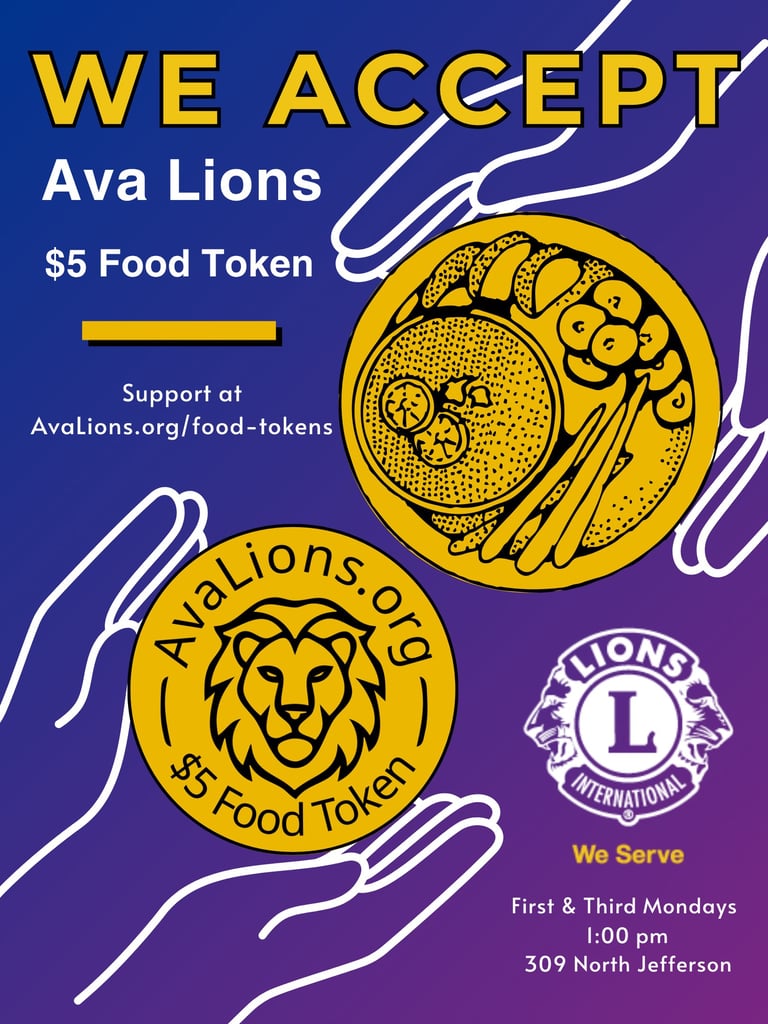
The food token system will utilize single-denomination $5 tokens. These tokens will be locally produced leather circular tokens, minimally decorated, and include basic information such as "$5 Ava Food Token AvaLions.org" for clarity.
These tokens will be distributed by the Ava Lions Foundation to various community organizations, including:
Food banks
Educational institutions
Churches and other ministries
The senior center and other social service offices
Other non-profit organizations
The distribution of tokens is contingent on prior funding to reimburse participating vendors. The criteria for eligible purchases is simple: any food product from participating vendor partners. Vendors will be required to contact the Ava Lions Foundation to return collected tokens for plain cash to simplify accounting.
Funding for the food tokens will be sourced from grants, direct donations, sponsorships, and other types of contributions. Churches and other donation sources can choose to directly support tokens they wish to distribute, or the Ava Lions Foundation can assist distributing organizations in seeking sponsorship or fundraising for donations.
Technology
Some have been interested in the technology added to the leather token. The Near Field Contact (NFC) technology is being used in conjunction with the difficulty physically reproducing the leather token for security against fraudulent reproduction.
How NFC Works
Short range: Devices must be within 4 centimeters (about 1.5 inches) of each other to connect.
Frequency: It operates on a 13.56 MHz radio frequency.
No pairing: Unlike Bluetooth, NFC requires no manual pairing code or long setup process.
Power sharing: Some tiny NFC tags do not need batteries because they draw a tiny bit of power from the reading device.
An open and reproducable scanning device is being developed with a Respberry Pi miniature computer to easily read the token, for validity and tracking of vendor reimbursement. These technologies should enable the program to expand to other Lions clubs or other areas and organizations. These technologies do not enable, nor serve any purpose for detailed tracking of individuals or specific purchases. Individual's data privacy is an important consideration in program design, only tracking partnership organizations participation and token usage at a minimal level.
A pilot of 100 tokens started this summer, June 2026.
The distributor partner is Heart of the Hills Food Harvest, located near the MOCH.
The vendor partners for the pilot are:
Jean's Healthway
The VFW
Air2Ground Meats
Ava Saturday Farmers Market participating vendors
Update August 2026
The pilot has been very successful so far, before the end of august we have already re-imbursed 25 of 100 tokens.
Findings from the program pilot so far include the ability to return any lost tokens to the original distributor, which enables the partner to then potentially return to the original recipient that dropped it if they are notified. We are considering a slightly smaller token design to ideally fit more easily in personal locations already storing regular coinage.
Another finding is that there will need to be specific rules added around cash change in a transaction. The addition should specify rules such that there is minimal inconvenience to both the token user and vendor, while still protecting the token system from abuse by finding the smallest price food item and receive cash for the excess over $5.
Program Pilot
How you can support!
You didn’t come this far to do nothing...
Connect Us with
Not for Profit Partners
We need partner organizations that reach people that are in need. Ideal partners include food banks, shelters, and religious organizations willing to sign a non-discriminatory agreement.
We need food distribution partners to sell food in exchange for food tokens. Ideal partners include locally owned farmer's markets, road side stands, and grocers.
We need funded tokens. Use the donate button below to donate. Each $5 donation is 100% allocated to fund a real token.
Connect Us with
Food Distribution Partners
Donote Now
Donate Food Tokens
Your $5 donation will fund the free use of this food token at local participating food vendors. Partners will distribute the prepaid tokens to those in need.
Distibutor Partnership
Distribute Ava Lions Food Tokens at your local organization